

If you’re considering franchise ownership, it’s essential that you understand the franchise system and franchise agreements. These set out your responsibilities and rights, and are the legal basis of your relationship with your franchisor.
At Your Future Franchise, Scott is your knowledgeable advisor. He works closely with potential franchise owners to guide them through the legal process with clarity and empathy. He’ll tell you what to expect at each step of your journey.
To give you a clear basic understanding of how franchise agreements work, here’s an entry-level rundown of what information the agreement contains and how it works in practice. We also cover some of the key legal requirements to start a franchise.
With this information and a chat with Scott, you’ll be able to proceed down the franchise ownership path with confidence.
Quick Key Takeaways
- Franchise agreements define the legal relationship between franchisor and franchisee.
- Agreements include fees, territory rights, obligations, operational rules and franchisor support levels.
- Understanding what information is included in a franchise agreement helps reduce risk
- The process involves research, validation, and careful review before signing a contract.
- Speak to Scott at Your Future Franchise for caring guidance, problem solving and any other assistance you need in setting up your business.
Franchise Agreements
A franchise agreement is a legal contract between you and the franchisor describing the franchise relationship. Franchise contracts grant you the right to operate under the brand umbrella and define specific systems and rules that you’re required to follow when operating your franchise. These documents can often be complex, which is why professional guidance from Scott will help you so much.
You should note that franchise agreements are different to a Franchise Disclosure Document (FDD). The latter is a document where you provide information about yourself, such as your financial and legal history. It’s more of a vetting document, whereas the agreement is the binding contract you sign that governs day-to-day franchise operations. Here’s more information on the difference between an FDD and a franchise agreement.
What information is included in a franchise agreement?
Having a clear understanding of the kind of information, rules and rights your franchise agreement contains is crucial to making the right decisions. By comparing different franchise contracts with the help of Scott’s expertise, you’ll be able to make the most informed decision.
How do franchise agreements work? Franchise agreements typically contain several main elements…
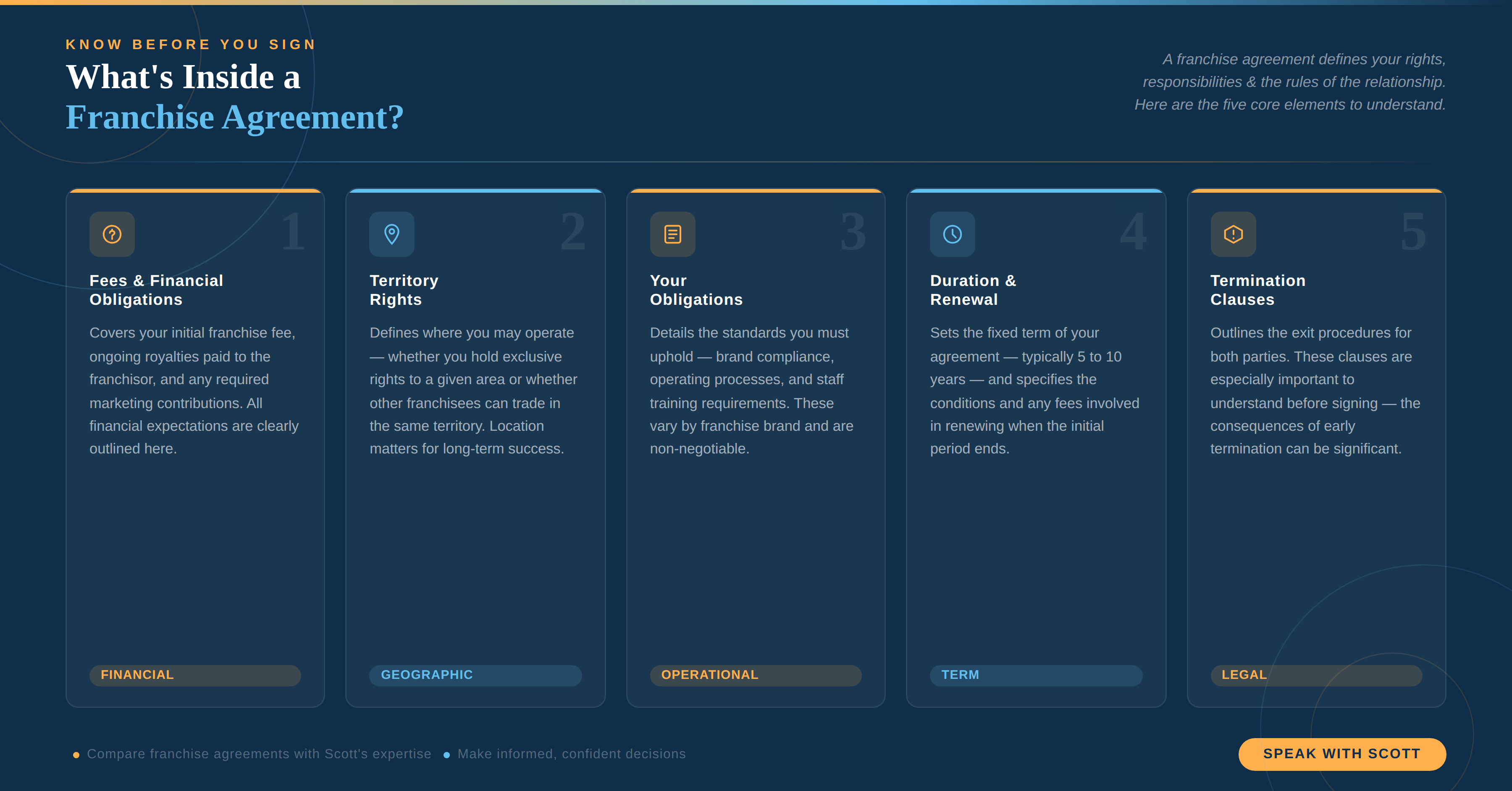
Fees and Financial Obligations
These are miscellaneous fees and responsibilities. They include your initial franchise fee, define ongoing royalties to the franchisor, and any marketing contributions that are expected of you. The franchise agreements will always outline these very clearly. Discuss them with Scott so that you don’t get any unwelcome surprises later.
Territory Rights
This element defines the rights you have to operate in specific locations. It will either grant you exclusive rights to a particular area or allow other franchisees to operate there as well. Carving out your own territory can have a significant impact on your long-term success, so try to find a convenient location where you have the sole operating rights.
Your Obligations
These will vary across different franchise brands. It covers how to follow the franchisor’s processes and systems. This section also describes the brand standards you’ll be expected to maintain, including the necessary training you and your staff will require.
Duration and Renewal
This part defines the length of your franchise agreement. Most are set at a fixed period, anywhere from five to 10 years. The contract will also specify conditions for renewal and explain if there are any fees involved.
Termination Clauses
These clauses outline the procedures if either party wishes to terminate the agreement. It’s particularly important to clearly understand these before signing franchise contracts.
How Do Franchise Agreements Work?
Signing the actual agreement isn’t the starting point of your franchise journey. This only comes after you’ve gone through a structured discovery and evaluation process of potential franchise opportunities.
There are several pre-agreement phases that will help you find the best fit for your ambitions.
- Start by researching industries that match your interests and goals and looking for available opportunities. At this point, talking to an expert franchise consultant like Scott can really help you home in on the best options.
- When you’ve identified a franchise brand that appeals to you the next step is to start engaging with the franchisor. Scott will assist you with introductory calls, creating compelling presentations and completing the FDD with you. It’s at this point that you’ll find out about the franchisor’s business model, expectations and the kind of support they’ll provide.
- Then you can conduct your own evaluation of the franchisor. The best way to get real-world insights is to chat to other franchisees to find out about their experiences in running their businesses under the franchise umbrella.
- Only once you’ve done all your research and are satisfied should you move on to the agreement stage. Review franchise agreements in detail before committing to the franchise relationship. Once again, Scott will be there to help you, and it’s also worthwhile getting additional legal advice.
The agreement becomes the blueprint for how you operate your franchise business and interact with your franchisor. It’s also your framework that defines performance requirements and how they’re measured. Think of it as both a set of rules and a guide to successful operation.
The Importance of Franchise Contracts
Franchise contracts are legally binding documents following franchise law and designed to protect both parties involved in the agreement. They give you the franchise agreement outlines, providing clarity, structure, clear operating principles and define compliance requirements. On the franchisor side, the protect intellectual property, systems, and brand identification and reputation.
Well constructed franchise contracts should avoid ambiguities and misunderstandings. It should clearly explain expectations, including operating standards, reporting obligations and compliance requirements.
The contract should also contain details on the kind of training and support you’ll get, and how to market your franchise following the brand’s guidelines. These sections explain exactly what the franchisor will provide and what is expected of you. There should also be a section on how to resolve any conflicts that may arise.
The best advice is to take as much time as you need to thoroughly understand everything in the contract. You’re free to ask as many questions as you like and to seek professional help. After all, this is a long-term commitment for you that isn’t without risks. Once again, you can rely on Scott at Your Future Franchise to walk you through each clause and explain it in ways that are easy to understand. We can’t stress enough how important this is to prevent issues arising later.
Requirements to Start a Franchise
Before you commit to any franchise agreements you have to fully understand the requirements to start a franchise. It’s just like any other endeavor: before you begin you must learn the basics. Franchising provides a structured roadmap into business ownership. It’s certainly not a ticket to overnight success. It takes hard work, dedication and a total commitment to building a successful operation.
1. Financial Readiness
This may seem obvious, but you need to be able to afford to carry your business through the launch phase and onwards until you’re earning enough revenue to cover all these expenses. You’ll need more than the initial franchise fee.
Think of set-up costs, working capital and ongoing costs until your new business has stabilized. Many new franchisees underestimate these overheads in the first few months. If necessary, you can use your financial statements to secure funding or a loan to cover these initial expenses. You need to start from a stable financial position. To help you with this, here’s more information on the costs of operating a franchise.
2. A Business Mindset
Not everyone is cut out for franchise ownership. It requires following tried and true business methods with discipline and consistency. You’ll also have to align with the franchise business model of the brand. Successful individuals are those who understand the business model, why it works and respect the system and procedures.
3. Time Commitment
Don’t think that running a franchise is a matter of popping in every few days to make sure everything is running smoothly. It requires far more commitment, especially during the start-up phase. You’ll likely find yourself fully involved every day. So you need to be realistic about how much time you can devote to your franchise and whether it will fit into your lifestyle. Bottom line: prepare for long hours and demanding work until your business is established.
4. Operational Capability
Operating a franchise business means managing internal processes, in-house staff and customer relationships. This requires a degree of flexibility as you learn. You won’t always have all the answers right from the beginning, so the ability to adapt and lead is crucial. You need to be the kind of person who is comfortable with constant problem solving and decision making.
5. Cultural Fit
Franchisors depend on brand consistency. So they evaluate how well prospective franchisees will fit into their brand culture. Start-up enthusiasm isn’t enough. Authenticity is the key. They want people who genuinely believe in their products or services and will become committed brand ambassadors. Here’s more on how to choose a franchise that fits you.

Final Takeaways on Franchise Agreements
Understanding franchise agreements is a crucial part of becoming a successful franchise owner. These documents define your relationship with the franchisor and set the framework for your business. By learning what information is included in a franchise agreement, you reduce risk and gain clarity.
The process of discovering how a franchise agreement works takes time and careful consideration. From initial research to signing franchise contracts, each step matters. Meeting all the requirements to start a franchise ensures you are prepared for the journey ahead.
You don’t have to navigate this alone. Scott at Your Future Franchise is here to help you make informed decisions. He’s not about selling you a franchise. His role is to help you determine if franchise ownership is right for you and help you grasp the ins and outs of franchise agreements. For reassurance, read about our other client experiences.
Book a Free Consultation with Scott
Frequently Asked Questions About Franchise Agreements
What is a franchise agreement?
A franchise agreement is a legal contract between a franchisor and franchisee that defines their business relationship, including rights, obligations, fees, territory, operational rules, and support levels.
How is a franchise agreement different from a Franchise Disclosure Document (FDD)?
The franchise agreement is the binding contract governing daily operations, while the Franchise Disclosure Document provides essential information about the franchisor and the franchise opportunity, helping prospective franchisees evaluate the business.
What fees are typically included in a franchise agreement?
Most franchise agreements require initial fees, ongoing royalty fees based on gross sales, and contributions to an advertising fund. These financial commitments are clearly outlined in the agreement.
Can a franchise agreement be terminated early?
Yes, termination clauses specify conditions under which either party can end the agreement, often including a cure period for franchisees to rectify issues before termination.
Am I allowed to sell my franchise?
Most franchise agreements require franchisor approval before transferring or selling the franchise, often involving an approval process and possible transfer fees.
Why is brand consistency important in franchising?
Brand consistency ensures customers receive a reliable experience at every franchise location, protecting the franchisor’s reputation and supporting repeat business.
What is the role of the Federal Trade Commission (FTC) in franchising?
The FTC regulates franchising by requiring franchisors to provide a Franchise Disclosure Document and ensuring franchise agreements meet legal standards to protect both franchisors and franchisees.
How do franchise agreements protect intellectual property rights?
They outline how franchisees may use the franchisor’s trademarks, trade secrets, and other intellectual property, ensuring brand protection and consistent use across all franchise locations.
What happens if disputes arise between franchisor and franchisee?
Franchise agreements typically include dispute resolution provisions, which may require mediation or arbitration before litigation.
Can franchise agreements be negotiated?
While some terms may be negotiable, many franchisors require uniform agreements to maintain brand standards and consistency across all franchise locations.