
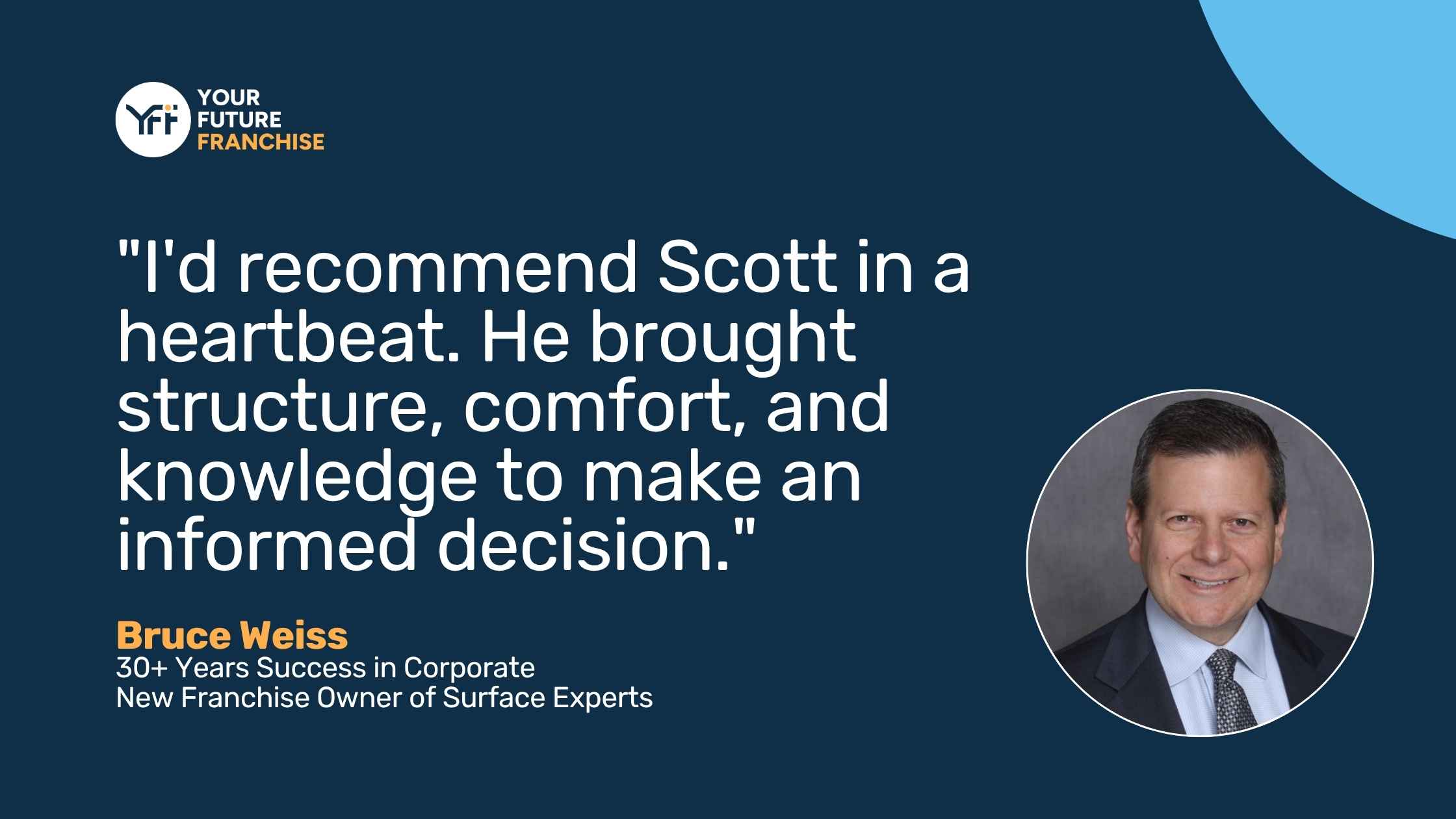
Bruce Weiss knows exactly what it feels like to want something for thirty years and not reach for it.
He built a corporate career most people would frame and hang on a wall, yet the idea of franchise ownership kept tapping him on the shoulder through every promotion.
This year, at the stage when many executives start winding down, Bruce wound up instead. He purchased a Surface Experts franchise serving central New Jersey, and he did it with our team at Your Future Franchise led by franchise consultant Scott Thompson who walked beside him through each step of the decision.
This is the story of how a consumer products veteran finally traded the boardroom for a franchise business of his own, and what his journey teaches entrepreneurs who want to open a franchise of their own.
Key Takeaways
✓ Scott started with Bruce, not with brands. He audited Bruce’s career, strengths, and lifestyle goals before presenting a single franchise opportunity.
✓ Scott presented a half dozen prescreened franchise opportunities, then used Bruce’s own research and reactions to narrow the field to four serious finalists.
✓ Scott sharpened Bruce’s questions before every validation call, so conversations with franchisees uncovered unit economics, support, and daily reality.
✓ Scott challenged Bruce’s assumptions and never pushed a deal, dropping any franchise Bruce ruled out and moving on without a sales pitch.
✓ Scott stays in Bruce’s corner after the signing, a commitment that shaped Bruce’s confidence as much as any number in the disclosure documents.
Thirty Years of Building Brands That Belonged to Someone Else
Every impressive career casts a quiet shadow, and Bruce lived in his for decades. He started out of college at the Coca-Cola Company, selling fountain syrup to bar and restaurant owners up and down the streets of New York City. Those small business owners taught him something no classroom could: every dollar counts when the margins are yours. He watched them fight for their profits and their independence, and he never forgot it.
An MBA from NYU’s Stern School of Business carried him into brand management at Nabisco, where he worked on Milk-Bone, A.1. Steak Sauce, and Altoids, products that sold millions of units in every corner of the country. He then spent nearly 20 years at Church & Dwight, the company behind Arm & Hammer, where he ran a health business generating a billion dollars in annual sales. He later served as CEO of a vitamin company and advised private equity firms and growth companies across the consumer products industry.
And still, the shadow. However high he climbed, Bruce remained an employee, with someone else dictating the pace and someone else owning the outcome. His father and grandfather had both owned businesses, and one piece of family wisdom refused to fade.
“It’s better to make one dollar for yourself than two dollars for somebody else.”
— Bruce Weiss, recalling his grandfather’s maxim, Surface Experts franchisee
Why Franchise Ownership Called Louder Than the Next Corporate Role
There is a moment in many corporate lives when the calendar becomes the argument. For Bruce, it arrived quietly: if you’re not going to do it now, you’re never going to do it. Nothing in his career was broken. He was proud of it. But pride in the past is not the same as ownership of the future, and Bruce wanted his own business, an asset with long-term value for himself and his family, built in the community where he lives.
Franchising made sense to him for a reason that resonates with almost everyone leaving corporate America: it pairs the freedom of running your own business with proven systems that already work. Instead of inventing a playbook, you execute one, backed by an established brand and the collective knowledge of other franchisees who have walked the road ahead of you. Franchise systems also spread the risks that independent owners carry alone, because the training, the support, and the network’s experience all lower the odds of an expensive mistake. For a man who had spent his business life watching execution beat excitement, that trade felt right. If that tension between a steady paycheck and a bigger life sounds familiar, our guide to leaving corporate America for franchising walks through it in depth.
What Bruce did not expect was the culture. Franchise systems, he discovered, run on more than royalties and manuals. Headquarters teams organize themselves around franchisee success, and owners help one another without being asked. “You feel like you’re working at something bigger, even though this is your franchise,” he says. He had planned for economics. He had not planned to find a common cause.
Finding the Right Franchise, Not Just the Top Franchises
Here is where most searches go wrong before they begin. The franchise industry publishes endless lists of top franchises, and they make compelling reading, but a ranking cannot know your savings, your strengths, or the hours you want to keep. Bruce understood this instinctively. The right franchise for a retired quarterback is the wrong franchise for a brand builder from New Jersey, and chasing top franchises by reputation alone is how capable people end up owning businesses they quietly resent.
A mutual friend, a franchise owner himself, introduced Bruce to Scott Thompson. What followed was not a pitch. It was a series of conversations about Bruce’s career, what he liked, what he was good at, and where he could use development. Only then did Scott present franchise opportunities, about a half dozen, each prescreened and matched to Bruce’s operating background. Unlike brokers, who may represent only a few franchisors and steer candidates toward whoever pays best, a franchise consultant works from fit. Scott used Bruce’s own due diligence, his reactions, and even his objections to refine the list, educate him, and put new options forward.
“You’re not dealing with just a salesperson, you’re dealing with an operator as well. He really knows his stuff.”
— Bruce Weiss on Scott Thompson, Your Future Franchise
Four franchise finalists emerged, and the funny thing, Bruce says, is how different they were from each other: different industries, different economic models, different levels of investment, business-to-business and business-to-consumer, even a real estate concept with high potential returns. Evaluating a franchise opportunity against three others taught Bruce more about himself than any single brand could have. If you are earlier in that education, the learn about franchising resources on the Your Future Franchise website are a good place to start.
Doing the Homework: How Bruce Evaluated Each Franchise Opportunity
Confidence is not a feeling. It is a stack of answered questions. Bruce treated diligence like the job it is, and Scott made every hour of it count. When Bruce drafted questions for validation calls, Scott sharpened them, steering him toward what actually mattered: the economics, franchisee satisfaction, territory potential, the support offered after opening, and what daily life inside the business really looks like. When Bruce asked something Scott couldn’t answer, the response was always the same. Go ask it, or I’ll find out for you. Scott’s relationships across the franchise industry also gave Bruce access to franchisor representatives who were known quantities rather than strangers, which changed the tone of every conversation.
Bruce did more than the required franchise validation calls. He contacted current franchisees on his own, including one with a consumer products background like his and another who came from law. He asked about their opening year, their growth since, and what they would change. Additionally, he scheduled in-person visits to two operating territories before his own launch, riding along with technicians to determine what a day in the business truly holds. Franchisors talk about their systems; franchisees show you the reality. The homework was validation, Bruce says, but it also taught him how he wanted to run his own business once he got out there. Anyone serious about buying into a franchise should contact current and former owners, study market demand in the specific territory, evaluate local competition, and have a lawyer review the franchise agreement and the Franchise Disclosure Document, which franchisors must provide at least 14 days before any signing. Franchising rewards people who research like Bruce did, because evaluating the financial, legal, and personal factors together is the entire game.
“You’re not taking a leap of faith. You’re taking an informed step.”
— Bruce Weiss, Surface Experts franchisee
What a Franchise Business Really Costs: Fees, Ongoing Costs, and Gross Sales
Money is where dreams meet arithmetic, so let’s be direct about the cost. Owning a franchise business involves a real investment, and Bruce would be the first to tell you the cash flow is lean while you build. The initial franchise fee typically runs from tens of thousands of dollars to several hundred thousand depending on the franchise brand, and that fee is only the entry ticket. Most new owners also purchase equipment, initial inventory, and insurance, and many franchisors require candidates to complete training before opening day.
Bruce compared the cost of entry across all four franchise concepts, because cost structures vary widely by industry. A home services franchise may cost a fraction of what a brick-and-mortar franchise demands once you build out a location, and the true cost of owning a franchise stacks the franchise fee, the setup, and the working capital that carries you until the business can pay you back. Candidates fund the purchase through savings, SBA financing, or retirement rollover programs. The right financing structure depends on how much access to capital you have and how much of your household’s living expenses it must cover while sales build.
The Recurring Fees Behind the Sticker Price
After opening, franchisees pay ongoing royalties to franchisors, usually a percentage of gross sales rather than profits, which means franchisors get paid on gross income whether your first year runs hot or cold. Advertising fees for national or regional campaigns flow into a shared advertising fund on top of royalty payments, and normal operating expenses like payroll, rent, accounting, and supplies continue every month. Franchise agreements can last up to 20 years with renewal options, so these recurring fees deserve the same scrutiny as the upfront investment.
What the Investment Buys: Proven Systems and Real Support
In exchange for the franchise fee and royalties, franchisors hand a new franchisee what independent founders spend five years assembling: an established brand, expert training, marketing and advertising resources, vendor relationships, and proven systems refined across the entire network. Strong franchise companies treat that support as an investment in each franchisee’s success, because a franchisor only grows when its owners succeed. That is the heart of the model. You are in business for yourself, but you are never relying on yourself alone.
A reality check worth writing down
Franchisees often see lower revenues in their first year, and average income claims may not reflect how any individual location performs. Franchisors must disclose earnings claims in the Franchise Disclosure Document, so treat numbers quoted anywhere else with caution. Bruce modeled the cost of every scenario across savings and lending options, planned for the lean months, and sized the investment to his balance sheet. That is what separates an informed buyer from a hopeful one.
Why Bruce Chose a B2B Service Franchise Opportunity
In the end, Bruce picked the least glamorous franchise of the four, and he picked it for the most personal reasons. Surface Experts repairs damage to countertops, tubs, floors, and other surfaces for property managers and maintenance managers, a niche where property teams responsible for millions in real estate value often don’t know the service exists until someone shows them a repair that saved a replacement. It is a true operator’s business: diverse customers, tangible results, and gross sales built one fixed surface at a time. Bruce loved that he could drive past a building and know his team’s work is inside it.
The brand recognition Surface Experts is building in the B2B world, plus the culture he felt from headquarters and other franchisees, sealed the decision. If that model intrigues you, our breakdown of B2B service franchise ownership explains why operators like Bruce gravitate toward it, and you can read the announcement of his franchise ownership success story for the full background.
Bruce also thought hard about durability. He doesn’t believe surface repair in apartments and hotels gets replaced by automation, and the message he heard from the franchisor and every franchisee was the same: follow the process, because the process is proven. This is a franchise industry truth that applies far beyond one brand. An established brand with proven systems, a service the market genuinely needs, and a support structure invested in his success: that is what the right opportunity looked like for him. Yours may look entirely different, which is precisely the point.
“The risk is not simply owning a business. It’s entering without a process.”
— Bruce Weiss, Surface Experts franchisee
The Right Opportunity Exists for You Too
If you have read this far, some part of Bruce’s story is probably your story. Maybe you have given twenty years to companies that would replace you in a quarter. Maybe you have business experience that deserves a bigger stage, or savings that should be building your future instead of waiting in an account. Hear Bruce clearly: he had no repair industry background whatsoever. What he brought was curiosity, discipline, and a willingness to learn, and the franchise system supplied the training, the resources, and the support to cover the rest. The risks feel smaller when a proven playbook absorbs them, and how you fund the leap matters less than how honestly you plan it. Success in this industry, he found, has less to do with what you did last year and more to do with how you show up in year one.
You do not have to make this leap alone, and you shouldn’t. A franchise consultant like Scott turns a fog of interested Googling into a structured franchise search to find the right franchise: honest conversations about your goals, prescreened opportunities that fit them, sharper questions for every franchisor, and a steady hand when your gut needs a second opinion. Bruce, a first-time franchisee, launched his franchise territory in under two months. His word for what he found through this process wasn’t income or exit. It was fulfillment. Whatever you are walking away from, a business of your own may be what you walk toward, and there is a version of Bruce’s fulfillment waiting for you to decide it’s time.
Ready to Take Your Own Informed Step?
Book a free consultation with Scott Thompson at Your Future Franchise. Scott isn’t here to sell you a franchise. He helps you assess whether you’re a strong candidate and whether owning a franchise is right for your goals, your finances, and your life. If you’re interested but unsure, that conversation is exactly where clarity starts. And if franchising isn’t your path, he’ll tell you that too. The candidates who have walked this road with Scott tell that story better than we can on our reviews page.
Questions People Ask Before They Buy a Franchise
What does a franchisor offer once you sign?
More than most first-time buyers expect. Franchisors provide initial training and an operating manual, and most require franchisees to complete training before opening. Many franchisors help new owners find a location for their outlet, provide marketing assistance and regular check-ins, and continue ongoing training and support through newsletters, workshops, and coaching as the brand evolves. Some franchisors also impose design and appearance standards, which protects the customer experience across the whole franchise system. The best franchisors treat each new franchisee as a long-term partner, because the franchise only grows when every location succeeds.
How much does it cost to open a franchise?
Franchisors set initial franchise fees anywhere from tens of thousands to hundreds of thousands of dollars, and the total investment adds equipment, initial inventory, insurance, and working capital on top, so the real cost to open a franchise runs well past the fee itself. After opening, expect ongoing royalties based on gross income plus advertising fees that feed a shared marketing fund. Additionally, you pay royalties on a percentage of gross sales every month, and the total cost of ownership includes operating expenses like rent, payroll, and insurance. Some franchisors even offer financing for part of the fee. Build an honest accounting of every layer before securing financing, and keep reserves for the months while sales ramp.
How long do franchise agreements last?
Franchise agreements typically last up to 20 years, often with renewal options, and the fees continue for the life of the term. That long horizon is why the Franchise Disclosure Document matters so much: franchisors must provide it at least 14 days before you sign, and a franchise lawyer should review both documents before any money moves.
How involved do franchisees need to be?
Owning a franchise is not a spectator sport. It varies by franchise concept, from hands-on owner-operators to more passive models with a manager running daily operations. Most franchisees handle day-to-day operations directly at the start, and some franchises require heavy involvement early, with the franchisee driving sales and building local relationships personally. Being present during the first year is critical for a new franchisee, and franchisee success tends to correlate with the time invested in the business.
Will I make money in my first year?
Plan conservatively. Franchisees usually see lower revenues in their first year while the customer base builds, and average income claims may not reflect how any individual franchisee performs. Franchisors must disclose any earnings claims in the Franchise Disclosure Document, so validate those numbers directly with current franchisees before you decide.
How do I know if a franchise will work in my area?
Established franchises rely on strong brand recognition and customer loyalty, so market demand analysis in your specific territory is crucial, alongside a clear read on local market conditions and competition. Visit local franchised outlets, talk to every current franchisee you can reach about their growth, and contact former owners as well. Their answers reveal more about profitability and support than any brochure or website.
Do I need help choosing a franchise, or can I go it alone?
You can go it alone, but consider what Bruce gained: prescreened matches, sharper diligence questions, industry knowledge accumulated over 25+ years, and an advocate with no incentive to push a bad fit. Franchise brokers may represent only a few franchisors; a consultant who prescreens both sides of the franchise match works differently. Study each franchisor’s website, read the disclosure documents, and evaluate every answer you collect against your own goals. Our learn about franchising page is a free way to keep exploring before you reach out through our contact page.