

Quick Answer
AI is eliminating roles at every level of corporate America, from data entry clerks to senior product managers.
But the same economic forces creating job displacement are also fueling record demand for franchise ownership in service based industries that artificial intelligence cannot replace.
Here we’re breaking down how AI adoption is reshaping the job market, which franchise categories remain resistant to automation, and how a structured advisory process helps mid-career professionals turn disruption into ownership.
How Smart Professionals Turn AI Disruption Into Franchise Opportunity
If you have $100,000 or more in liquid capital and want to stop waiting for the next round of layoffs, schedule a no-cost consultation with Your Future Franchise to evaluate your options.
AI business transformation has moved from boardroom theory to workplace reality faster than most career plans can keep up. According to McKinsey’s 2025 Global Survey on AI, 88% of organizations now use artificial intelligence in at least one business function, up from 78% just one year earlier. For professionals watching their departments shrink, the question has shifted from “will AI affect my career?” to “what do I do about it right now?” At Your Future Franchise, we work with people who have answered that question by choosing franchise ownership as a strategic next chapter.
What You Should Know Before You Start
How quickly is AI actually displacing jobs?
- The U.S. Census Bureau reported that AI usage among businesses hovered between 17% and 20% from December 2025 through May 2026, with another 20% to 23% planning to adopt AI tools within six months.
- The displacement is not theoretical. Real teams at real companies are being reduced because AI systems, AI agents, and machine learning tools now handle routine tasks that once required full departments.
- Roles most at risk include accounting, entry level coding, content production, data entry, outbound sales, and project management support.
Does franchise ownership protect you from AI disruption?
- Not every franchise model offers protection. A franchise built around tasks that AI technologies can automate carries the same risk as the corporate job you just left.
- The franchise categories with the strongest resistance to AI are those requiring physical presence, specialized trade skills, or high trust human interaction: home services, senior care, fitness, restoration, and commercial cleaning.
- Choosing the right franchise model matters more than choosing any franchise model. That decision requires a structured process, not a Google search.
What does it actually cost to buy a franchise?
- Total investment ranges vary widely. Some home based franchise models start under $75,000. Multi-unit food or fitness concepts can exceed $500,000.
- Most of the professionals we work with have between $100,000 and $200,000 in liquid capital, a net worth of $500,000 or more, and access to SBA lending or retirement fund rollovers (ROBS).
- The financial qualification process happens early. You should know your full investment picture before you evaluate a single brand.
Do I need industry experience to run a franchise?
- No. Most franchise systems train you from the ground up. Your transferable skills in management, operations, and leadership often matter more than technical trade knowledge.
- You hire the technicians. You run the business. That distinction makes franchise ownership especially appealing to executives and mid-career professionals who want to apply their corporate skill set to something they own.
88%
Of organizations now use AI in at least one business function (McKinsey, 2025)
52%
Of franchise companies now use AI in development, up from 23% one year prior (2026 AFDR)
25+
Years of direct franchise experience behind Your Future Franchise’s advisory process
$0
Cost to the candidate for the entire consulting process (franchisors pay the fee)
Table of Contents
- How AI Transformation Is Reshaping the Corporate Workforce
- Why Business Leaders and Laid Off Professionals Are Turning to Franchising
- Which Franchise Categories Stay Resilient During AI Disruption
- How AI Tools and AI Agents Are Already Changing Franchise Operations
- The Real Risks of Buying a Business Without a Structured Process
- What a Franchise Consultant Actually Does (And Why It Matters)
- Decision Making in an AI Driven Economy: How to Evaluate Franchise Fit
- Why Your Future Franchise Approaches This Differently
1. How AI Transformation Is Reshaping the Corporate Workforce
The AI transformation happening inside corporations right now is not a future scenario. It is a current event. Companies across finance, technology, marketing, and professional services are using generative AI, machine learning, and natural language processing to automate work that previously required full teams.
According to Deloitte’s 2026 State of AI in the Enterprise report, two-thirds (66%) of organizations report productivity and efficiency gains from enterprise AI adoption. Worker access to AI rose by 50% in 2025, and a full 34% of surveyed organizations are now using AI to deeply transform their businesses by creating new products, services, or reinventing core processes.
What does that look like on the ground?
- AI systems handle data analysis, forecasting, budgeting, and financial reporting that once required teams of 8 to 10 people
- Generative AI tools produce marketing copy, customer communications, and internal documentation at a fraction of the previous cost
- AI agents manage customer interactions, supply chain logistics, and incident response workflows around the clock
- Natural language processing powers virtual assistants that replace call center teams and front line support roles
The PwC 2026 Global AI Jobs Barometer found that productivity growth at companies most exposed to AI runs 40% higher than at companies least exposed. That is a competitive gap no board of directors can ignore, and it explains why layoffs continue even when revenue holds steady.
Watch Out
AI adoption is not limited to entry level jobs. According to McKinsey, 32% of survey respondents expect decreases in overall workforce size at their organizations within the coming year. Senior managers, product owners, and specialized analysts are all on the list. If your company has started talking about “efficiency” and “doing more with less,” the restructuring may already be underway.
Artificial intelligence reduces forecasting errors by 20% to 50% compared to traditional methods. AI algorithms analyze historical data to predict future trends, forecast demand, and identify patterns in consumer behavior that human teams might miss. AI powered tools streamline operations across supply chain management, customer experience, and marketing strategies with less human intervention than ever before.
For professionals watching this play out from inside a corporate role, the math gets personal fast. The question stops being abstract and starts sounding like: what happens when my team goes from 30 people to 3?
2. Why Business Leaders and Laid Off Professionals Are Turning to Franchising
Across Reddit forums, LinkedIn groups, and career transition communities, the same conversation keeps surfacing. Professionals who spent 15 to 25 years climbing corporate ladders are realizing those ladders may not exist in two years. Many are exploring business ownership for the first time.
One Reddit user in a recent thread about AI layoffs summed up a feeling shared by thousands: “My company is being transformed by AI. It’s painfully obvious that you need a much smaller team to do the same work, and when you have fewer engineers, you need less support. Fewer managers, fewer PMs.”
Franchising gives these professionals something that starting a business from scratch does not: a proven system. You get an established brand, operational training, a customer acquisition model, and ongoing franchisor support. You bring your executive skills, your management experience, and your capital. The franchisor brings the playbook.
Good to Know
If you are still employed and considering franchise ownership, act while you have W2 income. Lenders look more favorably at candidates who apply before they leave their corporate role. Severance packages can supplement your liquid capital, and SBA loans typically require proof of steady income at the time of application.
According to the 2026 Annual Franchise Development Report, 52% of franchise companies now use AI in their franchise development process, up from just 23% one year prior. Franchising is not ignoring the AI transformation. The best franchise systems embrace AI technologies to make their operations more efficient while keeping humans at the center of service delivery.
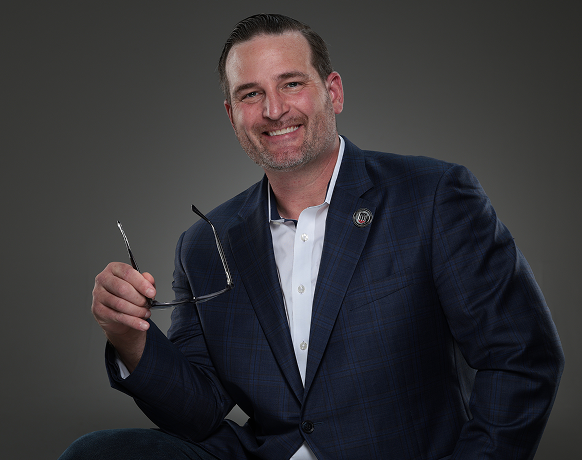
Scott Thompson
Lead Franchise Consultant, Your Future Franchise
“Franchising right now is going to boom in the U.S. because of AI. A lot of these entry-level jobs or specialized jobs like coding, accounting, legal, even entry-level sales jobs, like outbound sales stuff, all those jobs are going to go away. But the economy is still booming because productivity is still strong. Companies are still making money. They’re just laying people off.”
The professionals who make this transition most successfully share a few traits. They have management experience. They understand P&L statements. They know how to hire and lead teams. These skills transfer directly into franchise ownership without requiring trade certifications or years of apprenticeship.
75% of business leaders now consider AI a strategic priority. That same urgency to adopt AI is creating the conditions that push talented people out of roles they have held for years. The question is whether those people react or respond with a plan.
3. Which Franchise Categories Stay Resilient During AI Disruption
Not all businesses survive AI transformation equally. Franchise models built around work that requires a physical presence, specialized manual skills, or deeply personal human interaction carry natural protection against automation.
The categories performing strongest right now include:
- Home services (HVAC, plumbing, electrical, restoration, cleaning): every job happens in a unique physical environment requiring on site problem solving
- Senior care and healthcare services: compassionate care, emotional support, and safety monitoring require human caregivers. AI enhances scheduling and documentation, but it does not replace the human touch
- Fitness and wellness: personal training, recovery services, and boutique studios thrive on in person accountability and community
- Commercial cleaning and property maintenance: contract based recurring revenue with physical labor that AI and robotics cannot replicate at scale
- Pet services: grooming, daycare, and boarding depend on trust, safety protocols, and animal handling skills that require human presence
AI can personalize customer experiences through behavior analysis. AI driven chatbots can manage customer inquiries around the clock. AI powered tools can streamline operations and reduce human error. But none of these AI applications can crawl into a crawl space to repair a furnace, comfort an elderly person during a medical episode, or safely groom a nervous dog.
Pro Tip
When evaluating franchise brands, ask specifically how the franchisor uses AI systems to support franchisees. The best systems use AI technologies for scheduling optimization, lead routing, customer satisfaction tracking, and predictive maintenance alerts. They also automate repetitive tasks in back office operations so franchisees spend less time on paperwork. The worst systems sell you a territory and leave you to figure it out alone.
The Franchise Journal’s 2026 AI Proof Playbook highlighted the same pattern: franchise categories rooted in specialized physical presence, high trust human care, and recurring service demand show the strongest resilience against technological advancements. Predictive maintenance, real time data analysis, and AI driven customer experience improvements make these businesses run better without making the human operators replaceable.
4. How AI Tools and AI Agents Are Already Changing Franchise Operations
Embracing AI is not just for corporate giants. The smartest franchise systems already use artificial intelligence to give their franchisees a competitive edge at the unit level.
What AI adoption looks like inside a modern franchise operation:
- AI agents handle inbound lead qualification, appointment scheduling, and follow up communications so franchisees can focus on service delivery rather than executing routine tasks manually.
- Machine learning models analyze customer behavior and customer preferences to optimize marketing strategies, allocate resources, and deliver predictive analytics on revenue trends.
- Deep learning and neural networks power advanced analytics that help franchise owners identify patterns in equipment performance, allowing predictive maintenance before breakdowns happen. These same deep learning models process big data across multiple locations to surface insights a single operator would miss.
- AI models process existing data from CRM systems to forecast demand, track customer satisfaction, and flag accounts at risk of churn.
- Large language models, generative AI platforms, and natural language tools help franchisees produce accurate responses to customer inquiries, generate proposals, and create localized marketing content.
- Virtual assistants powered by generative AI handle after hours customer interactions, freeing owners from 24/7 availability while maintaining service quality.
Companies using AI in customer service saw a 13.8% increase in resolved chats, according to industry research. AI enhances customer loyalty by providing instant, accurate responses and 24/7 support. These AI systems handle complex tasks like real time data analysis and supply chain optimization that would require entire departments in a traditional business context.
The point is not that AI replaces the franchise owner. The point is that AI powered tools make a single owner-operator more capable than a team of five was a decade ago. That changes the economics of small business ownership in a meaningful way.
5. The Real Risks of Buying a Business Without a Structured Process
The AI transformation pushing people toward business ownership also creates a dangerous urgency. People who feel their jobs disappearing tend to rush. They skip due diligence. They fall for marketing stories. They make six figure decisions based on emotion rather than data.
In Reddit threads about career transition, this pattern shows up constantly. One user wrote about looking into franchise ownership after layoffs: “The startup costs were so significant that I was uncomfortable taking on the debt. And since I am in my 40s, was concerned about being able to pay it off, become profitable, and then to exit when I want to retire.”
That is a legitimate concern, and it is exactly the kind of concern that gets addressed properly only through a structured evaluation process. A serious investment in any franchise brand should come after, not before, you have completed the following:
Checklist: Before You Sign a Franchise Agreement
- Completed a financial qualification assessment with a funding consultant
- Built a candidate profile covering lifestyle goals, transferable skills, risk tolerance, and income requirements
- Reviewed the Franchise Disclosure Document (FDD) with a franchise attorney
- Completed validation calls with existing franchisees
- Compared at least three franchise opportunities on operational facts, not marketing
- Developed a working capital plan and understood your burn rate during the ramp up period
- Consulted a CPA on tax strategy, entity structure, and funding mechanics
Only 23% of companies have implemented AI training programs, which means most organizations are pushing technology changes without preparing their people. The parallel in franchising is this: most franchise candidates walk into the process without preparation either. They respond to ads. They talk to franchise salespeople. They hear the best version of every story. Without a structured advisory process, the decision making gets clouded by excitement and pressure.
90% of businesses have started digital transformation efforts, but only one third actually realized the benefits they expected. The same gap applies to franchise investment. Starting is easy. Getting the outcome you planned for requires process, discipline, and experienced guidance.
6. What a Franchise Consultant Actually Does (And Why It Matters)
A franchise consultant does not sell franchises. That distinction matters more than most people realize when they first enter the franchise space.
The role of a franchise consultant is to work with candidates, not for franchisors. A good consultant spends time understanding your background, your goals, your finances, and your risk tolerance before recommending a single brand. The process takes weeks, not days, because the decision making involved carries real financial and lifestyle consequences.
Scott Thompson
Lead Franchise Consultant, Your Future Franchise
“We want to spend time on your skills. Your background, your lifestyle you want to create for yourself, your long-term goals, risk mitigation, so many other factors that we want to look at. We spend a lot of time going through that and building a customized business model that fits your needs.”
A structured advisory process should do three things:
- Strip away franchise marketing and focus on operational reality
- Test whether the business model actually fits your goals and lifestyle
- Compare multiple opportunities on facts, not emotion or hype
Bryon Sergeant, a recent franchise candidate, described his experience this way: “You really get the opportunity to check your boxes, identify things that you didn’t even know, to set yourself up from the get-go.” He also noted that validation calls with existing franchisees surfaced questions he had not even considered, giving him a much broader picture before making his decision.
The alternative to this process is what most people default to: Googling “best franchises to buy,” getting overwhelmed by hundreds of options, and either picking the one with the best marketing or getting stuck and doing nothing. Neither outcome serves you well during a period of economic change driven by AI adoption.
7. Decision Making in an AI Driven Economy: How to Evaluate Franchise Fit
Decision making under uncertainty is something every corporate professional has done. Evaluating a franchise opportunity uses the same muscle. You gather data and test assumptions. You talk to people who have done it. You build a financial model and then you make an informed call.
The evaluation framework should cover several areas:
- Lifestyle alignment: Does the business model match the daily life you actually want? Semi-passive ownership looks different from owner-operator models. Both work, but for different people.
- Financial modeling: What does the total cost of operation look like? Not just the franchise fee, but working capital, build out, hiring, ramp up, and ongoing royalty and marketing fund contributions.
- Market demand: What does demand look like in your specific territory? National averages mean nothing if the local market is saturated or underserved.
- Franchisor strength: How mature is the franchisor’s support system? Training programs, technology stack, supply chain efficiency, and operational efficiency at the unit level all matter.
- AI readiness: Does the franchisor use AI tools and AI technologies to improve business performance? Or are they still running on spreadsheets and manual processes?
AI enhances decision making through data analysis. AI algorithms analyze historical data to predict future trends. But the decision to invest six figures into a business is not one that should be outsourced to a search engine or a chatbot. It requires human judgment, experienced counsel, and a process designed to protect you from expensive mistakes.
Good to Know
AI systems hallucinated up to 27% of the time in 2023, according to industry research. That means AI generated content and recommendations carry a real error rate. When you are making a decision that involves your savings, your career, and your family’s financial future, data quality matters. Work with human advisors who understand your business context and can verify what AI models cannot.
Bruce Weiss, a former consumer products executive who recently purchased a franchise through Your Future Franchise, described the process this way: he felt Scott was “somebody who was trying to get me to do something that was a great fit for me and would be a great fit for the franchise too.” He also noted that he never felt like he was working with a salesman. That distinction matters when your next career move involves a six figure commitment.
8. Why Your Future Franchise Approaches This Differently
Most franchise consultants work from lead lists. They get your information. They send you a batch of brands. They follow up until you sign or disappear. That model does not serve the candidate. It serves the transaction.
Your Future Franchise operates on a different premise. Scott Thompson built this practice around his own experience as a franchisee, a franchisor, and a franchise development executive at the private equity level. He has more than 25 years of direct experience across every side of the franchise relationship. He teaches at the University of Georgia. He prescreens both candidates and franchise brands before making introductions.
What that looks like in practice:
- A seven step consulting process that begins with understanding who you are, not which brand to pitch you
- Access to the FranChoice network for direct, prescreened franchisor connections across more than 250 brands
- A curated portfolio of 10 to 12 high performing franchise brands that meet specific quality, support, and investment criteria
- A full support team of attorneys, CPAs, funding consultants, and wealth advisors who specialize in franchise transactions
- Ongoing availability after the franchise is awarded. The relationship does not end at signing
And there is no cost to you for any of it. Your Future Franchise is paid by franchisors. The candidate never pays a consulting fee.
Scott Thompson
Lead Franchise Consultant, Your Future Franchise
“I don’t go away when you work with me. So I have resources to help you, whether it’s wealth management stuff, CPA work, tax strategy work. I have resources that can allow you to talk to people before you make decisions. So you almost have your own little board of directors.”
Kristin Flaherty, who recently went through the franchise discovery process with Scott, described his approach as genuinely personal. She said he was good about “not necessarily trying to shut down any emotions or feelings that I was having, but just helping me understand what can we do about that, or why am I feeling that way.” That level of individual attention is what separates a structured franchise consulting process from a transactional one.
Related Resources for Franchise Candidates
If you are weighing your options, these guides cover the most common questions we hear from professionals working through their first franchise decision:
- Buying Into a Franchise: What You Need to Know
- How to Choose a Franchise That Fits Your Life
- Timeline of Buying a Franchise
- Franchise Development Tips
- Leaving Corporate for Franchising
- Scaling Franchise Growth Tips
Ready to Stop Waiting and Start Building?
Schedule a no-pressure consultation with Scott Thompson and the Your Future Franchise team. There is no cost to you for the entire consulting process. We are paid by franchisors, not candidates. Bring your questions, your concerns, and your goals. We will tell you whether franchise ownership makes sense for your situation.
Frequently Asked Questions About AI Business Transformation and Franchise Ownership
Can AI really replace my corporate job?
Artificial intelligence is not replacing every job, but it is reducing the number of people needed to do the same work. When AI agents handle data analysis, customer interactions, and automating repetitive tasks that used to require full teams, companies keep fewer employees on the payroll. McKinsey’s 2025 survey found that 32% of respondents expect workforce decreases at their organizations within the next year. What remains valued is human creativity, strategic thinking, and the ability to manage complex tasks that require judgment. If your role involves routine tasks that generative AI can automate, the risk is real and worth planning around.
What types of franchises are most resistant to AI?
Franchise categories rooted in physical labor, specialized trade skills, and in person human trust tend to carry the strongest protection. Home services (HVAC, plumbing, electrical), senior care, fitness and wellness, commercial cleaning, and pet services all require a human presence that AI and robotics cannot replicate at current capability levels. The key factor is whether the core service requires someone physically on site performing work that varies by location and situation.
How much money do I need to buy a franchise?
Investment ranges vary widely by franchise model. Home based and service based models can start under $100,000 total investment. Multi-unit, brick and mortar, or food service concepts often require $250,000 to $500,000 or more. At Your Future Franchise, most candidates have $100,000 to $200,000 in liquid capital and a net worth of $500,000 or above. Funding options include SBA loans, ROBS (Rollover for Business Startups), and home equity lines of credit. We recommend connecting with a funding consultant early in the process.
Is a franchise consultant the same as a franchise sales representative?
No. A franchise consultant works on behalf of the candidate. A franchise sales representative works for the franchisor. The consultant prescreens brands, evaluates fit, and guides you through the entire process from self-assessment through closing. A sales rep is focused on selling you their specific brand. Working with a consultant who has no financial incentive to push any particular brand protects you from bias during the evaluation and agreement process.
How long does it take to go from exploration to franchise ownership?
The typical timeline from first consultation to franchise award runs 60 to 120 days, depending on the brand, the candidate’s readiness, and the complexity of funding. The process includes self-assessment, brand investigation, FDD review with an attorney, validation calls with existing franchisees, and financial structuring. Rushing this process almost always leads to worse outcomes. Learn more about the full timeline here.
Can I own a franchise while still working my corporate job?
Yes, depending on the model. Many service based franchises support semi-passive ownership, where you manage the business alongside a general manager and field team. This structure lets you maintain W2 income during the startup phase and transition to full time ownership once the business reaches operational stability. Not every franchise model supports this. A good consultant will filter brands based on your availability and desired level of daily involvement.
How do I know if franchising is the right move for me?
You start by getting honest with yourself about what you want your life to look like in 3 to 5 years. Do you want to build equity in something you own? Do you want to work with a team? Can you handle the financial uncertainty of the first year? Are you coachable and willing to follow a system? The right franchise fit considers your working style, your values, your financial position, and the lifestyle you want to build. That self-assessment work comes first, and it is exactly where a structured consulting process adds the most value.
Will AI tools help me run a franchise better?
Absolutely. AI powered platforms handle scheduling, lead management, customer communication, marketing optimization, and business performance analytics with increasing accuracy. AI agents process customer interactions at scale. AI models identify patterns in operational data that help you make faster, smarter decisions about staffing, inventory, and sustainable growth. Viewing AI as a business partner rather than a threat gives you an operational efficiency advantage over competitors who resist adoption.
What makes Your Future Franchise different from other franchise consultants?
Scott Thompson has more than 25 years of direct experience as a franchisee, a franchisor, and a franchise development executive. He teaches at the University of Georgia. He uses the FranChoice network for prescreened brand connections. He works with a curated portfolio of 10 to 12 high performing brands rather than pitching hundreds. His process starts with understanding your goals, not with a brand pitch. And the entire consulting process costs you nothing because Your Future Franchise is paid by franchisors. AI business transformation is changing how people think about their careers. Your response to it should be just as strategic.